Back to Patterns
bearish Signal
Descending Triangle
A descending triangle is a bearish continuation pattern defined by a flat horizontal support line and a declining resistance line connecting progressively lower highs. Sellers are in control, and the pattern typically resolves with a breakdown below support.
How to Trade
Enter short when price closes below the flat horizontal support line on elevated volume. The profit target is the height of the triangle projected downward from the breakdown point.
Market Psychology
Sellers are willing to sell at lower and lower prices — each rally is weaker than the last. Buyers are barely holding the support line, absorbing selling but gradually being worn down. When support finally breaks, the trapped longs are forced to sell, accelerating the decline.
Technical Diagram
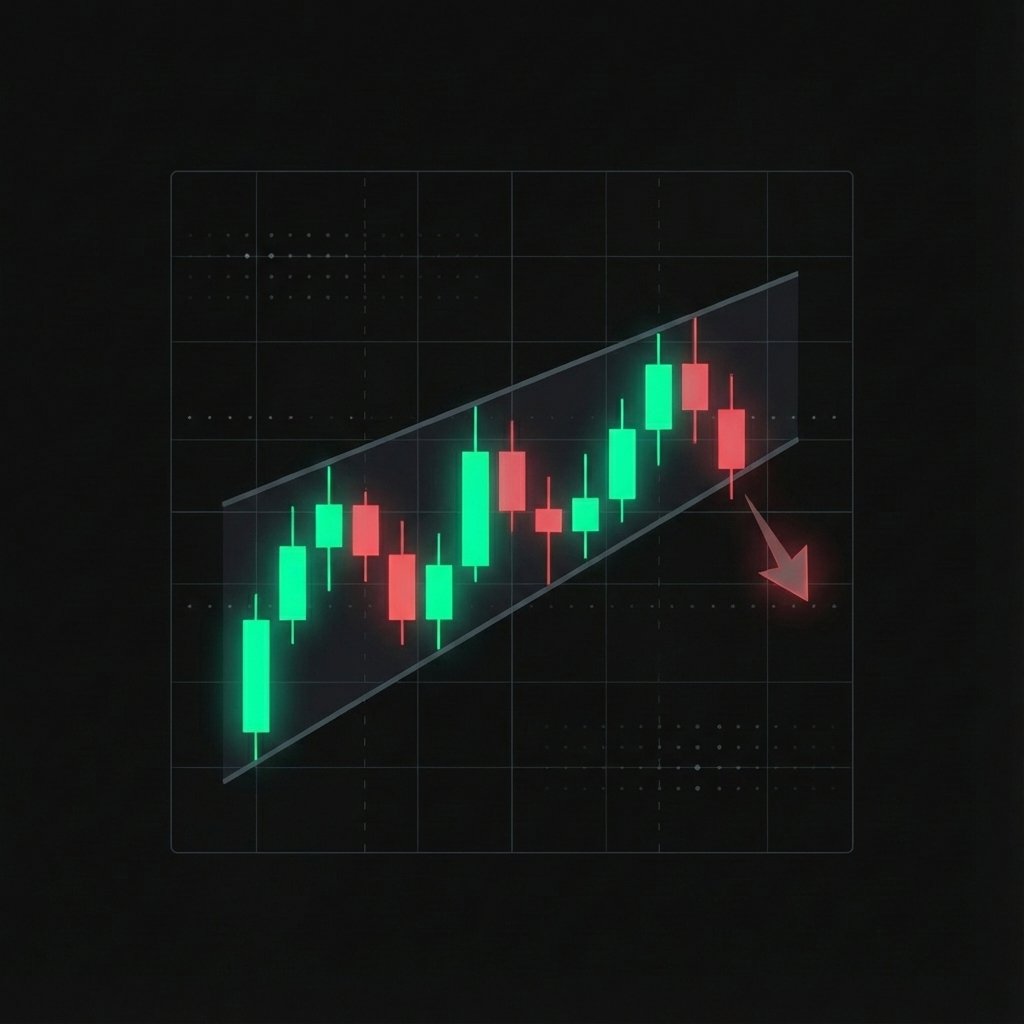
This visual represents the ideal candle formation and breakout points for the Descending Triangle pattern.
Key Characteristics
A flat, horizontal support line created by at least two lows at approximately the same price level
A descending resistance line connecting at least two progressively lower highs
At least 4 contact points (2 on support, 2 on resistance) for a well-formed pattern
Volume generally contracts during the pattern and expands on the breakdown
Price typically breaks down in the lower two-thirds of the triangle
Trading the Descending Triangle
Entry Signals
Enter short on a confirmed candle close below the flat support line on above-average volume. Some traders prefer to wait for a brief bounce back to the now-broken support (which becomes resistance) and enter short at that retest for a better risk-reward entry. Avoid entering too close to the apex.
Risk Management
Place the stop above the most recent lower high within the triangle or just above the midpoint. The pattern is considered failed if price breaks back above the descending resistance line before the support breaks. Exit promptly if price re-enters the triangle after a breakdown.
Profit Targets
Measure the height of the triangle at its widest point on the left (from horizontal support up to where the descending line begins). Project that distance downward from the breakdown point. This gives the minimum expected move.
Timeframes
Most effective on daily and weekly charts where the descending triangle represents meaningful institutional selling. Intraday patterns are common in downtrending markets and can provide quick short-side trades, but require disciplined stop management due to countertrend noise.
Volume Context
Volume should contract throughout the triangle formation. The key signal is a volume surge on the breakdown below support — this confirms genuine selling pressure and a high-probability continuation. A breakdown on low volume is frequently a false breakdown and should be treated cautiously.
Historical Success Rate
Descending triangles have a downward breakout rate of approximately 72% according to Bulkowski's research, with an average decline of 31% from the breakdown point. The pattern's reliability increases with more trendline touches and longer duration on daily charts.
Common Mistakes to Avoid
Entering short before the support line breaks — the horizontal support can hold for an extended time, and premature shorts get repeatedly stopped out
Trading near the apex without a breakout — late-stage apex breakdowns are less reliable than those occurring in the first two-thirds of the triangle
Missing the breakdown retest entry — a bounce back to the broken support (now resistance) often provides a superior short entry
Ignoring the broader market context — descending triangles in bull markets fail more often than those in downtrending markets
Not accounting for volume — a breakdown on average or low volume has a much higher probability of reversing
Descending Triangle — Frequently Asked Questions
What is a descending triangle?
A descending triangle is a bearish continuation pattern with a flat support line and a declining resistance line (lower highs). It signals that sellers are in control and that a breakdown below support is likely. The pattern is confirmed when price closes below the flat support line with elevated volume.
How reliable is the descending triangle?
Descending triangles have a downward breakout probability of approximately 72% based on Bulkowski's research, making them one of the more reliable bearish patterns. Reliability increases with more trendline touch points and when the pattern forms during an existing downtrend.
What is the profit target for a descending triangle?
Measure the height of the triangle at its widest point (on the left side). Project that distance downward from the breakdown point. For example, if the triangle is 5 points tall and the breakdown is at 50, the target is 45.
Can a descending triangle break to the upside?
Yes — approximately 28% of descending triangles break upward. This most often occurs in strong bull markets where the broader trend overwhelms the short-term bearish consolidation. Always wait for a confirmed breakout with volume rather than assuming the direction in advance.