Back to Patterns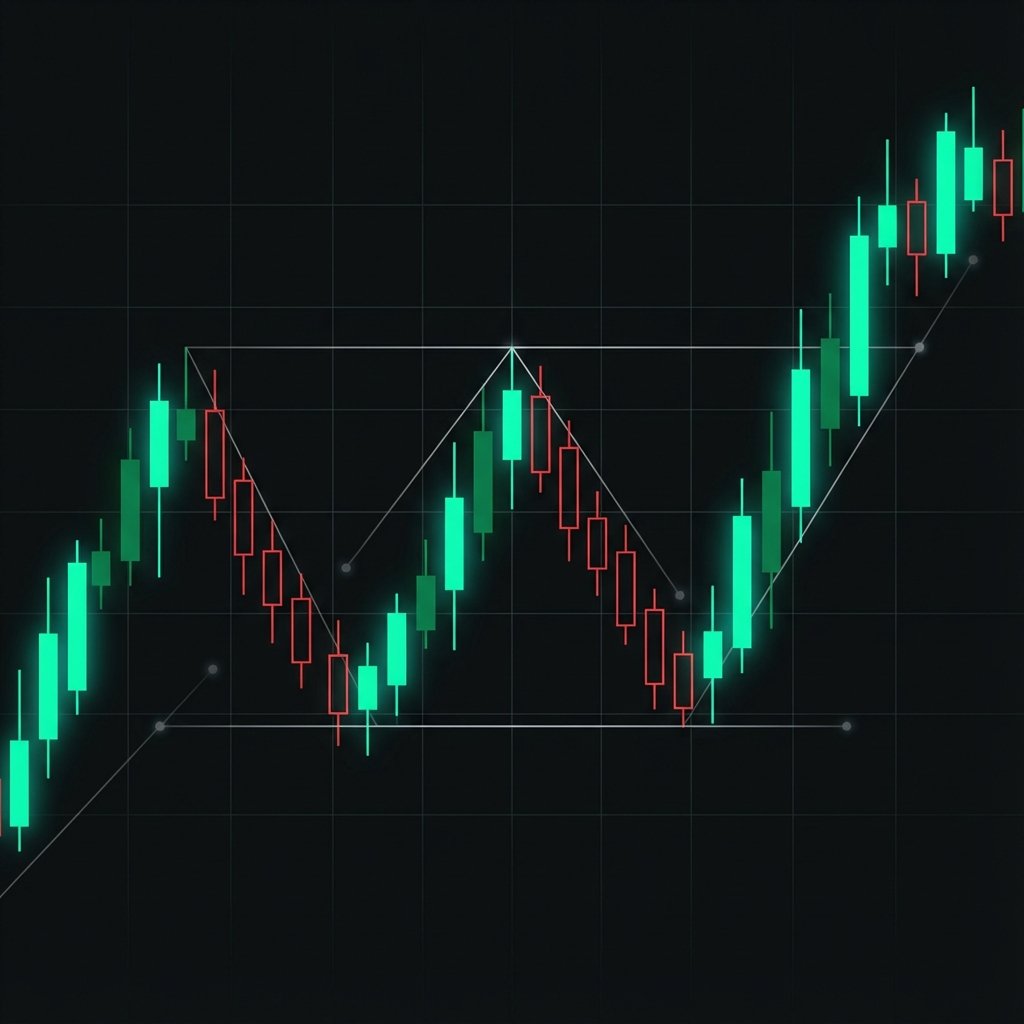
bullish Signal
Double Bottom
A double bottom is a major bullish reversal pattern that occurs after an extended downtrend. It resembles the letter "W," showing two distinct lows at a similar price level separated by a peak, signalling that selling pressure has been exhausted.
How to Trade
The pattern is confirmed when the price breaks above the neckline (the peak between the two bottoms) on strong volume. Many traders wait for a pullback retest of the neckline before entering to improve their risk-reward ratio.
Market Psychology
The first bottom shows buyers stepping in aggressively at a support level. After a partial recovery, sellers push price back down but fail to make a new low at the second bottom — a critical sign of seller exhaustion. When the price rallies through the neckline, it confirms the shift from bearish to bullish.
Technical Diagram
This visual represents the ideal candle formation and breakout points for the Double Bottom pattern.
Key Characteristics
Two distinct price lows at approximately the same level, forming the letter "W"
The two lows should be separated by a peak (the neckline), typically 10–20% above the lows
Volume is often higher on the first bottom and increases significantly on the neckline breakout
The second bottom frequently has lighter volume than the first, signalling seller exhaustion
The troughs should ideally be separated by at least 4–6 weeks on daily charts for the pattern to be meaningful
Trading the Double Bottom
Entry Signals
The primary entry is on a confirmed candle close above the neckline on above-average volume. A more conservative — and often higher-quality — entry is to wait for a pullback to the neckline after the initial breakout, and enter long as the price bounces off the now-support neckline.
Risk Management
If entering on the neckline breakout, place the stop below the second bottom. If entering on a neckline retest, a tighter stop just below the retest low is acceptable. The neckline break entry risks are larger, so size positions accordingly.
Profit Targets
Measure the distance from the neckline to the bottom of the troughs. Project that distance upward from the neckline breakout point. This gives the standard minimum price target. Strong double bottoms after prolonged downtrends can exceed this target significantly.
Timeframes
Most meaningful on daily and weekly charts, where the pattern reflects significant institutional accumulation. Intraday double bottoms (on 15-minute to 4-hour charts) are common but carry less weight and should be traded with tighter stops.
Volume Context
Volume should be higher on the first bottom and declining at the second bottom — this contraction confirms that sellers are drying up. The critical volume event is the neckline breakout, which should be accompanied by a strong surge in volume confirming that buyers are in control.
Historical Success Rate
Double bottom patterns are among the most studied reversal setups. Research by Thomas Bulkowski found that double bottoms have an average success rate of approximately 64–78% when the neckline is broken with confirming volume. The pattern is more reliable when the two troughs are well-separated in time.
Common Mistakes to Avoid
Entering too early — before the neckline is broken — treating the second low as an automatic buy signal
Ignoring the depth of the "W" — the troughs must be clearly defined, not shallow wiggles
Dismissing asymmetrical patterns — the two lows do not need to be at exactly the same price, just approximately equal
Not waiting for volume confirmation on the breakout — a low-volume neckline break often fails
Missing the neckline retest opportunity — this second entry often provides a better risk-reward ratio than the initial breakout
Double Bottom — Frequently Asked Questions
What is a double bottom pattern?
A double bottom is a bullish reversal pattern that forms after a downtrend. It consists of two lows at approximately the same price level (the "W" shape), separated by a peak called the neckline. When price breaks above the neckline, it confirms the reversal and signals a likely uptrend.
How do I trade a double bottom?
The two main entry strategies are: (1) Buy the breakout above the neckline with a stop below the second bottom, or (2) Wait for the price to pull back to the neckline after breaking out, and buy the retest with a stop below the retest low. The second approach often offers a better risk-reward ratio.
What is the price target for a double bottom?
The standard target is measured by calculating the distance from the neckline down to the bottom of the troughs, then projecting that distance upward from the neckline breakout point.
How do I know if the two lows are "close enough" to form a valid pattern?
The two lows should be within approximately 3–5% of each other in price. They do not need to be at exactly the same level. What matters is that the second low represents a failure to break through the first low, demonstrating that sellers cannot push the price lower.