Back to Patterns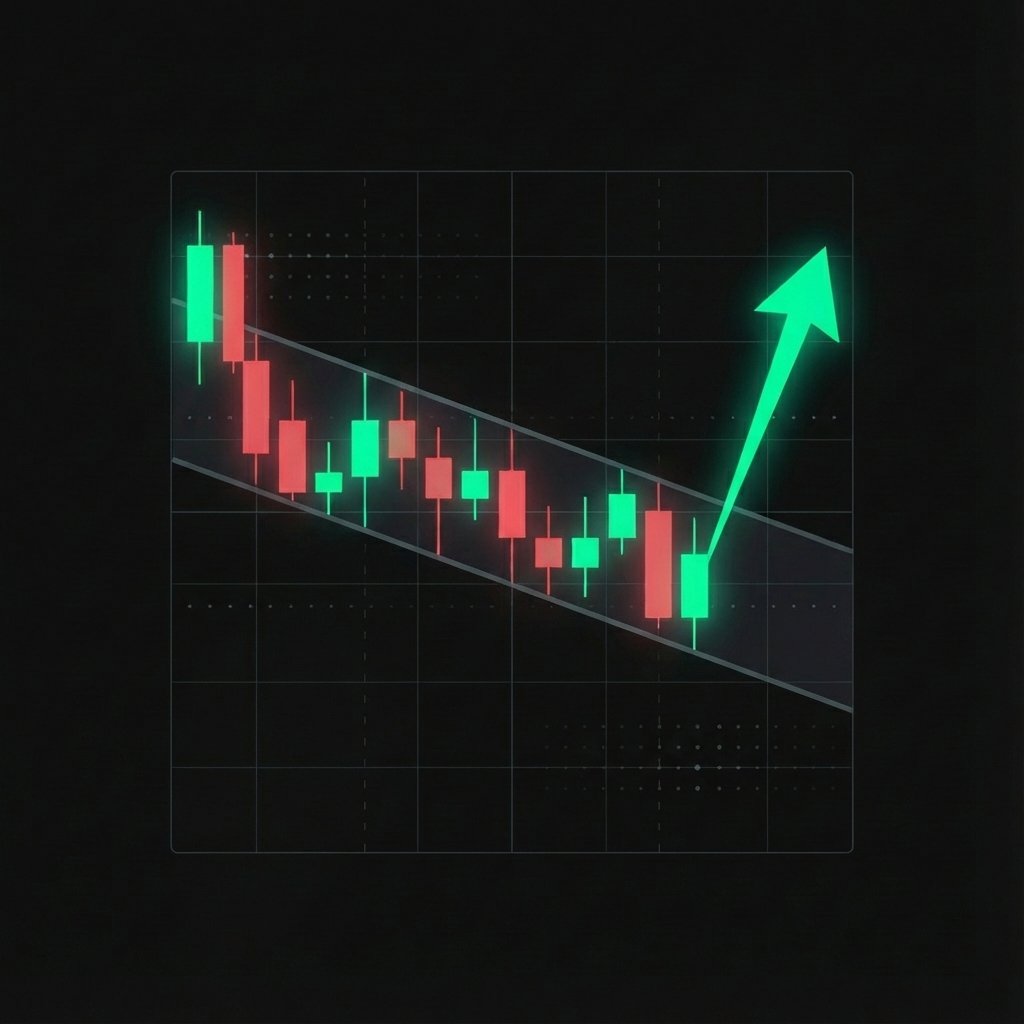
bullish Signal
Falling Wedge
A falling wedge is a bullish reversal or continuation pattern that forms when price makes lower lows and lower highs within a narrowing channel that slopes downward. The contracting range signals that selling pressure is diminishing, and the pattern typically resolves with an upward breakout.
How to Trade
Enter a long position when price breaks above the upper resistance trendline of the wedge on a confirmed candle close, ideally accompanied by a volume surge. The price target is typically the height of the wedge projected upward from the breakout point.
Market Psychology
Each drop in the falling wedge is smaller than the last, showing that sellers are running out of momentum. Buyers are absorbing more and more selling pressure without the price declining much further. The breakout above the upper trendline signals that buyers have fully taken control.
Technical Diagram
This visual represents the ideal candle formation and breakout points for the Falling Wedge pattern.
Key Characteristics
Price makes lower highs and lower lows within two downward-sloping, converging trendlines
The lower support trendline has a steeper slope than the upper resistance trendline
Volume declines throughout the wedge, showing decreasing selling conviction
At least 4 contact points (2 on each trendline) are needed for a valid pattern
A breakout above the upper resistance trendline on above-average volume confirms the pattern
Trading the Falling Wedge
Entry Signals
Enter long on a confirmed candle close above the upper resistance trendline. Look for a meaningful volume expansion on the breakout candle. A common alternative entry is to wait for a pullback to the broken upper trendline (now acting as support) after the initial breakout, which offers a tighter stop and improved risk-reward ratio.
Risk Management
Place the stop below the most recent swing low within the wedge or just below the lower trendline. Risk 1–2% of capital per trade. The pattern is invalidated if price makes a new low below the wedge's lower trendline. Exit promptly if price re-enters the wedge after a breakout.
Profit Targets
Measure the height of the wedge at its widest point on the left side (from upper to lower trendline). Project that distance upward from the breakout point. A second common target is the price level at which the wedge started — the origin of the initial downmove that formed the wedge.
Timeframes
Falling wedges appear across all timeframes. On daily and weekly charts, they can signal the end of major corrections in uptrending assets. On intraday charts (15-minute to 1-hour), they appear within downtrends and offer high-probability long trades during consolidations. Context within the larger trend is important for correctly classifying the pattern as a reversal or continuation.
Volume Context
Volume should contract progressively during the wedge formation — the declining volume reflects dwindling selling pressure as sellers struggle to push price lower. The breakout above the upper trendline should be accompanied by a noticeable surge in volume, confirming buyer conviction. A breakout on light volume is a warning sign and may not follow through.
Historical Success Rate
Falling wedges have a reported upward breakout rate of approximately 68% according to technical analysis research. As a reversal pattern at the bottom of a downtrend, the pattern tends to produce particularly large moves. Patterns that form over longer timeframes (4+ weeks on daily charts) and break out with strong volume tend to outperform.
Common Mistakes to Avoid
Buying inside the wedge before the breakout — the wedge can continue lower, stopping premature longs out
Confusing a falling wedge with a descending channel — a falling wedge has converging trendlines; a descending channel has parallel ones
Ignoring the volume contraction inside the wedge — this is a key validity signal for the pattern
Missing the trendline retest entry opportunity — after the breakout, a test of the broken trendline often provides a cleaner, lower-risk entry
Trading falling wedges that form in the middle of strong downtrends in weak markets — context matters significantly for this pattern
Falling Wedge — Frequently Asked Questions
What is a falling wedge pattern?
A falling wedge is a bullish pattern where price makes lower highs and lower lows within a downward-sloping converging channel. The contracting range and declining volume show sellers are losing strength. A breakout above the upper trendline signals buyers are taking control.
Is a falling wedge bullish or bearish?
A falling wedge is bullish. Despite the downward price action during formation, the converging trendlines and declining volume signal that selling pressure is exhausting. The breakout above the upper trendline confirms the bullish reversal or continuation.
What is the profit target for a falling wedge?
Measure the maximum height of the wedge at its widest point (the left side) and project that distance upward from the breakout point. Alternatively, use the starting point of the wedge's formation as a price target, as the pattern often fully retraces the prior decline.
What is the difference between a falling wedge and a descending triangle?
In a falling wedge, both trendlines slope downward and converge (bullish). In a descending triangle, the lower support is flat while the resistance descends (bearish). The direction of the support line is the key differentiator.