Back to Patterns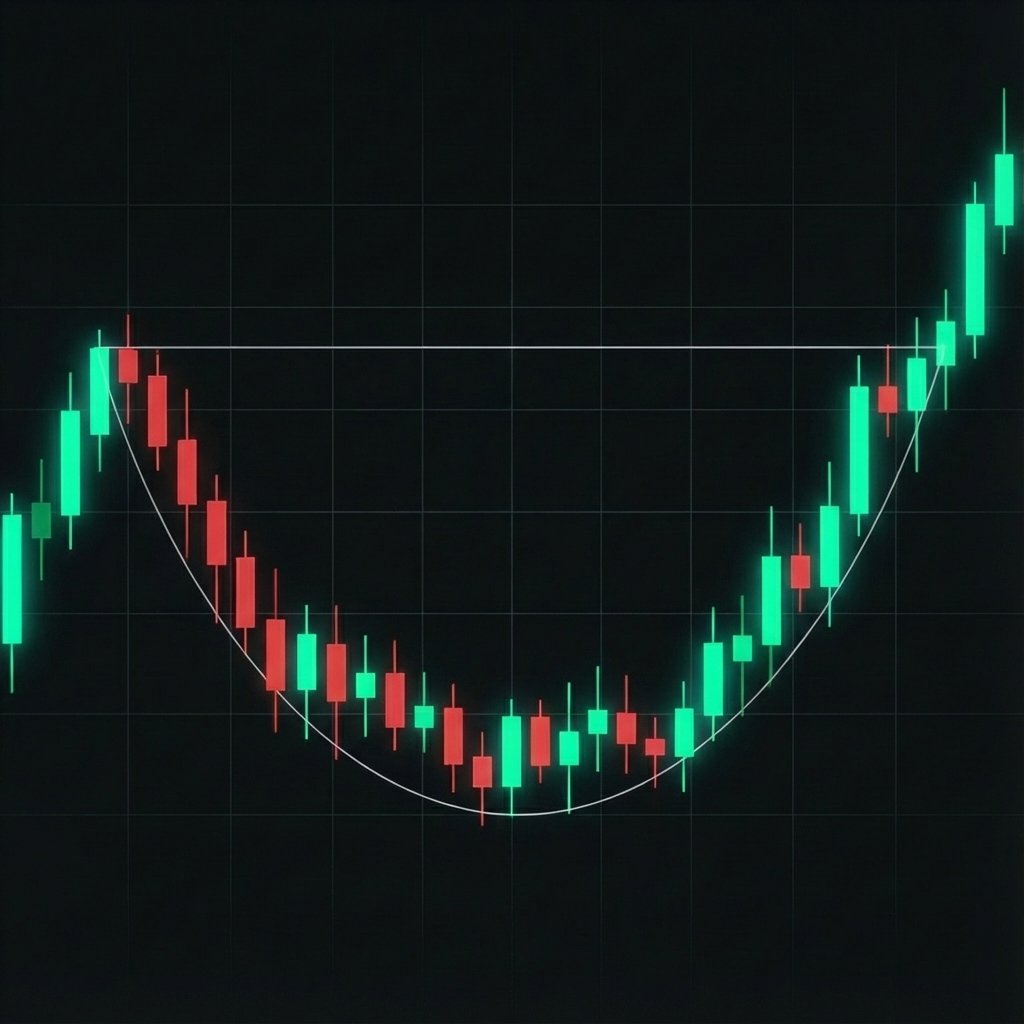
bullish Signal
Rounding Bottom
Also known as a "saucer bottom," the rounding bottom is a long-term bullish reversal pattern that shows a gradual, sustained shift from a downtrend to an uptrend. The price forms a smooth, U-shaped curve over an extended period, representing a slow but decisive change in market sentiment.
How to Trade
The pattern is confirmed when price breaks above the resistance level at the "lip" of the saucer — the high point before the rounded base began. Enter long on this breakout with volume confirmation. The profit target is the depth of the saucer projected upward from the breakout.
Market Psychology
This pattern represents the most gradual transition from selling to buying in technical analysis. Early sellers complete distribution and exit. A quiet accumulation phase follows as smart money builds positions at low prices over months. As buying gradually absorbs remaining supply, price curves higher. The lip breakout marks the moment public awareness catches up to what the smart money already knows.
Technical Diagram
This visual represents the ideal candle formation and breakout points for the Rounding Bottom pattern.
Key Characteristics
A long, smooth, U-shaped or bowl-shaped price curve with no sharp V-shaped moves
Extended formation period — typically 3 to 12+ months on daily charts
Volume mirrors the price pattern: high at the start of the decline, low at the bottom, rising on the right side
A clear "lip" resistance level at the starting point of the rounded base
A breakout above the lip level with a surge in volume confirms the pattern
Trading the Rounding Bottom
Entry Signals
The primary entry is the breakout above the lip (the prior resistance level). Wait for a confirmed daily candle close above the lip with a meaningful volume increase. Because the pattern takes months to form, missing the initial breakout by a few percent is acceptable — better to confirm than to anticipate. Some traders also add to the position on any pullback to the lip after the breakout.
Risk Management
Place the initial stop below the right-side low of the rounded base, or below the lip if entering on a post-breakout pullback. Because this is a long-term pattern, larger stop distances are often required. Size the position to risk 1–2% of capital regardless of the stop distance.
Profit Targets
Measure the depth of the saucer from the lip to the lowest point of the base. Project that distance upward from the breakout. Given the long consolidation period, rounding bottoms often produce multi-month or even multi-year uptrends that far exceed the initial measured target. Consider using trailing stops to capture the full extent of the move.
Timeframes
Most powerful on daily and weekly charts, where the extended accumulation phase represents meaningful institutional buying. Monthly charts can show rounding bottoms at major secular lows. Intraday rounding bottoms do occur but are less reliable due to the shorter consolidation period.
Volume Context
Volume is a mirror image of price in this pattern. It is highest at the beginning of the decline (distribution), dries up significantly at the bottom of the saucer (accumulation is quiet), and gradually rises as price curves up on the right side. The lip breakout should be accompanied by the highest volume seen in months, confirming strong institutional buying.
Historical Success Rate
Rounding bottoms are among the most reliable long-term reversal patterns when formed on weekly or monthly charts. Research indicates success rates of 74–86% for well-formed patterns on daily charts. The extended formation period means the pattern filters out noise and represents genuine, sustained accumulation rather than short-term volatility.
Common Mistakes to Avoid
Entering before the lip breakout — during the long formation, the pattern can extend or fail without the lip being broken
Expecting a V-shape or sharp rebound — rounding bottoms require patience; the gradual curve is the defining characteristic
Ignoring volume on the right side of the pattern — volume should increase as price rises on the right side; flat volume is a warning signal
Confusing a rounding bottom with a cup and handle — a cup and handle has a handle (a small pullback) after the cup, while a rounding bottom typically goes straight to the breakout
Underestimating the magnitude of the eventual move — long-base rounding bottoms often produce much larger moves than the initial measured target
Rounding Bottom — Frequently Asked Questions
What is a rounding bottom pattern?
A rounding bottom (or saucer bottom) is a long-term bullish reversal pattern showing a slow, gradual transition from a downtrend to an uptrend. The price forms a smooth, wide U-shape over months to years. The pattern is confirmed when price breaks above the "lip" — the resistance level at the starting point of the base.
How long does a rounding bottom take to form?
On daily charts, rounding bottoms typically take 3 to 12 months or more to fully develop. On weekly charts, they can span years. The longer the base, the more powerful the eventual breakout tends to be — a principle summarised as "the longer the base, the higher in space."
What is the profit target for a rounding bottom?
Measure the depth of the saucer from the lip down to the lowest point of the base. Project that same distance upward from the lip breakout point. Given the long accumulation, these patterns often generate moves that significantly exceed the initial measured target.
How is a rounding bottom different from a double bottom?
A double bottom has two distinct, sharp V-shaped lows at approximately the same level with a peak between them. A rounding bottom has a single, gradual, smooth U-shaped curve without sharp lows. The rounding bottom takes longer to form and represents a more gradual accumulation process.