Back to Patterns
neutral Signal
Symmetrical Triangle
A symmetrical triangle is a neutral consolidation pattern where price makes both lower highs and higher lows, with both trendlines converging toward a point. It represents a temporary pause and balance between buyers and sellers before a decisive breakout in either direction.
How to Trade
Wait for a confirmed breakout above the upper trendline (go long) or below the lower trendline (go short). The direction of the preceding trend and the breakout direction should ideally align. Do not trade inside the triangle — wait for confirmation.
Market Psychology
Both buyers and sellers are becoming more tentative, each unwilling to push the price decisively in their direction. This creates a narrowing range that compresses market energy like a spring. When one side finally overwhelms the other, the breakout releases that built-up energy in a strong directional move.
Technical Diagram
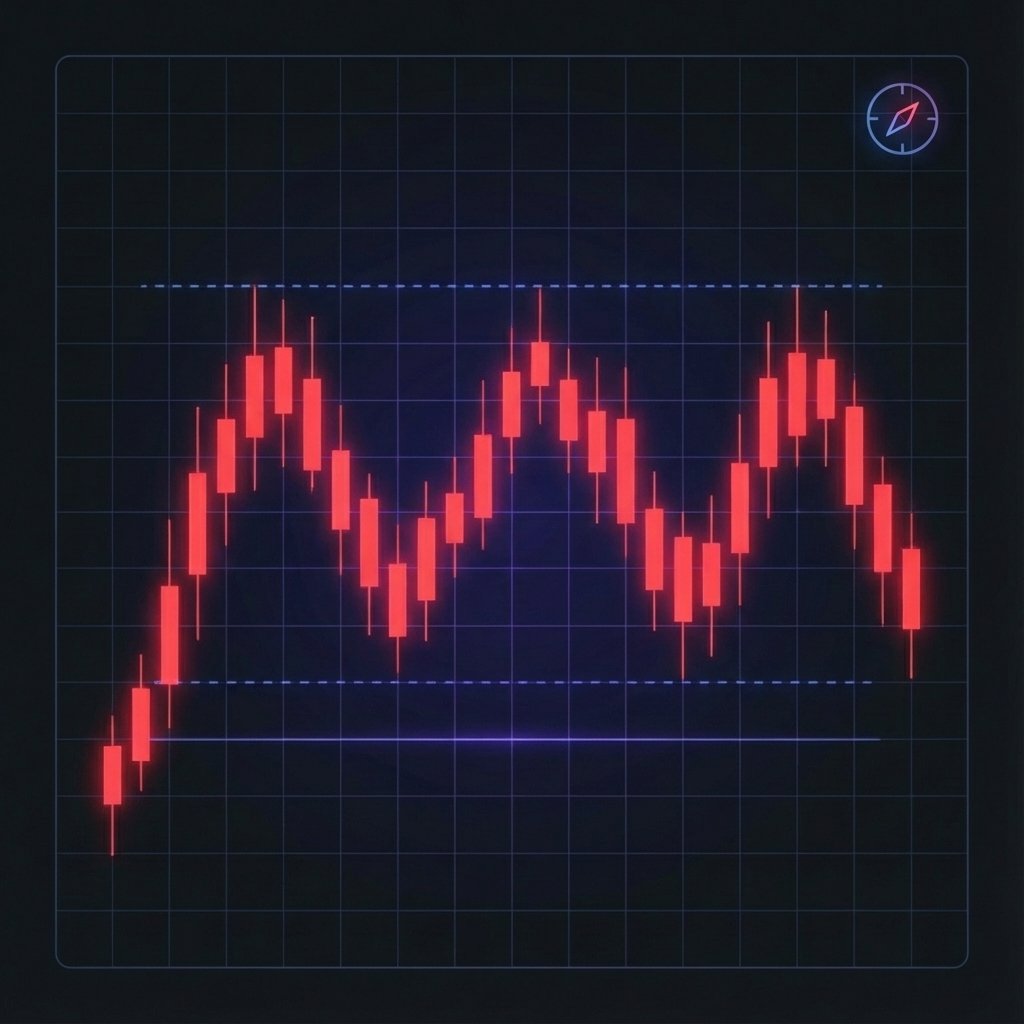
This visual represents the ideal candle formation and breakout points for the Symmetrical Triangle pattern.
Key Characteristics
Both trendlines converge symmetrically — the upper trendline slopes down and the lower trendline slopes up
At least 4 contact points (2 on each trendline) are needed for a valid formation
Volume contracts steadily throughout the pattern as the price range narrows
Price typically breaks out before reaching the final 20–25% of the triangle (the apex zone)
Following a prior uptrend, the breakout is more likely to be upward; following a downtrend, more likely downward
Trading the Symmetrical Triangle
Entry Signals
Enter in the direction of the breakout on a confirmed candle close outside the trendline boundary. The breakout candle should ideally show a volume surge. Set entries just outside the trendline rather than well into the move. If the prior trend was up, favour long breakouts; if down, favour short breakouts.
Risk Management
For a long breakout: place the stop below the breakout candle low or below the lower trendline. For a short breakdown: place the stop above the breakdown candle high or above the upper trendline. Risk 1–2% of capital per trade. The pattern is invalid if price reverses back through the opposite trendline.
Profit Targets
Measure the height of the triangle at its widest point (the left side). Project that distance in the direction of the breakout from the breakout point. A secondary target is the start of the consolidation pattern — where the triangle began forming.
Timeframes
Valid across all timeframes. On daily and weekly charts, symmetrical triangles often form as consolidation patterns between major trend legs. On intraday charts, they provide short-term trade opportunities. The pattern is most reliable when it forms in the direction of the broader trend.
Volume Context
Volume contraction during the triangle formation is expected and confirms the coiling of market energy. The breakout candle should show a significant volume expansion relative to the low-volume triangle — this volume surge is the key signal that the breakout is genuine. A low-volume breakout from a symmetrical triangle has a high rate of false breaks.
Historical Success Rate
Symmetrical triangles have an upward breakout rate of approximately 54% and a downward breakout rate of about 46% overall, making them nearly equal in both directions. However, when forming within the context of an existing uptrend, the upward breakout probability rises to approximately 68%. The prior trend direction is the most important factor in predicting the breakout direction.
Common Mistakes to Avoid
Trading inside the triangle — the pattern has not resolved until a breakout occurs; trading inside is guessing, not pattern trading
Assuming the breakout will always be in the direction of the prior trend — symmetrical triangles can break either way; always wait for confirmation
Entering on a low-volume breakout — false breakouts from symmetrical triangles are common and are most likely to occur on below-average volume
Letting price reach the apex before taking action — breakouts in the final 20% of the pattern are statistically less reliable
Using the same target for both directions — while the measured move technique applies to both directions, the prior trend context affects how far the post-breakout move typically extends
Symmetrical Triangle — Frequently Asked Questions
What is a symmetrical triangle?
A symmetrical triangle is a consolidation pattern with converging trendlines — a downward-sloping upper line and an upward-sloping lower line. It reflects market indecision and can break in either direction. A confirmed candle close outside either trendline with volume expansion is the entry trigger.
Is a symmetrical triangle bullish or bearish?
A symmetrical triangle is neutral — it can break in either direction. The prior trend is the best predictor: triangles forming within an uptrend more often break upward (~68%), while those in downtrends more often break downward. Always wait for volume-confirmed breakout direction before trading.
How do I set a profit target for a symmetrical triangle?
Measure the height of the triangle at its widest point on the left. Project that distance in the breakout direction from the breakout point. For example, if the widest point was 10 points and the upside breakout occurs at 50, the target is 60.
How is a symmetrical triangle different from a wedge?
Both feature converging trendlines, but in a wedge, both lines slope in the same direction (both up in a rising wedge; both down in a falling wedge), giving the pattern a directional bias. In a symmetrical triangle, the trendlines slope in opposite directions, keeping the pattern neutral.